Showing posts with label creative nonfiction writing. Show all posts

Wednesday, May 1, 2019

The ABCs of Book Writing: T is for TITLE . . .

Infographic for Blog Series on Book Writing and Publishing
View larger image: Right click;
then left click "Open link in new
window." Zoom to 200% or
preferred size.
. . . to capture your THEME.

"What's in a name?" asks William Shakespeare's Juliet. "That which we call a rose / By any other name would smell as sweet." Compelling though this sentiment is, what might apply to floral names does not typically work for book titles. In fact, an apt title enhances both the artistry and marketability of a book, while a poorly chosen title can subvert a book's intention and meaning, and adversely affect its reception. This is true of both fiction and nonfiction.

If an author has a conventional book contract, the publishers will often step in and insist on renaming the work. This can be a mixed blessing, as the publisher's title will often be catchier and more marketable than the author's but will not necessarily reflect the book's content with strict faithfulness. Publishers typically have the power to override the author's title preference but will usually concede the author's right to give input. My advice to any author faced with a publisher's title is to listen to your own instinct. If the new title sounds good to you, then run with it and everyone is happy. But if you strongly dislike the publisher's title, then risk being considered difficult and advocate for your own title. You might not win this battle but at least you will have the satisfaction of having stood up for your own creation.

Some writers appear to have a natural feel for a good title and are quick to devise one or more concise and compelling options for naming their manuscripts. Many others, myself among them, struggle with titles and never quite feel that we've chosen wisely. I know of no easy way out of this dilemma. But at least the possibilities for titles are numerous, and awareness of how others have successfully titled their books may set you thinking in some new direction that will eventually lead to a title that works for you and your manuscript.

Here, for both fiction and nonfiction, are some title categories and examples of each:

Novels


Humor/whimsy/irony/satire


The Hitchhiker's Guide to the Galaxy
MASH
Catch-22

Concepts


Pride and Prejudice
Sense and Sensibility
Magnificent Obsession

Metaphors


Gone with the Wind
To Kill a Mockingbird

Literary references


For Whom the Bell Tolls
The Sound and the Fury
Brave New World

Biblical references


East of Eden
Song of Solomon
A Time to Kill
The Tower of Babel

Character names


- Moll Flanders
- Fanny Hill
- Joseph Andrews
- Jane Eyre
- David Copperfield
- Oliver Twist
- The Great Gatsby
- Rebecca
- Cross
- I, Alex Cross

Setting or place names


Wuthering Heights
A Room with a View
Hawaii

Single words 


The thriller writer Jonathan Kellerman is a notable contemporary master of the one-word title—

- Rage
Gone
Compulsion
Deception
Victims
- Motive

—to cite just a few.

Creative nonfiction


Also known as narrative nonfiction, creative nonfiction, includes such genres as history, true crime, biography and memoirs, and uses many novelistic techniques. This alliance of fiction and nonfiction is reflected in the many creative nonfiction titles that derive from sources similar to those that have inspired the naming of novels. Here are a few examples:

My Family and Other Animals (humor/whimsy)
The Russian Album (metaphor)
The Pebbled Shore (literary reference)
All Creatures Great and Small (hymn reference)
All Things Bright and Beautiful (hymn reference)
Angela's Ashes (subject's name)
Dietrich (subject's name)
Liverpool Miss (place name)
Lime Street at Two (place name)

Expository nonfiction


Expository nonfiction, such as self-help, how-to, and motivational books, tends to look less to outside inspiration for its titles and more to capturing the main content of a book. This imperative typically, though not always, requires the use of a title-subtitle combination. In today's world of Internet marketing, another consideration for titles is the need to provide meaningful keywords for online searches. Here are some representative examples of expository nonfiction titles and subtitles:

Stand-alone title: The Seat of the Soul
One-word title + explanatory subtitle: Quiet: The Power of Introverts in a World That Can't Stop Talking
Short title + concise subtitle: The Wealthy Barber: Everyone's Commonsense Guide to Becoming Financially Independent; Emotional Intelligence: Why It Can Matter More than IQ
Short title + long subtitle: Necessary Losses: The Loves, Illusions, Dependencies, and Impossible Expectations That All of Us Have to Give Up in Order to Grow
-Title + shorter subtitle: The 7 Habits of Highly Effective People: Powerful Lessons in Personal Change

Brainstorming titles


Not inspired by the examples listed above? Then try brainstorming a range of words and concepts, and combining and recombining them until some potentially viable titles emerge. Just Google "book title generators" and you will discover a number of websites that generate titles either randomly or by your choice of genre and words relating to your book's content. To my mind, many such titles have an awkward or contrived feel, but title generators might nonetheless stimulate your thoughts and spark that just-right title for your book.

Book titles matter


As Google results and the sampling of titles given here show, when it comes to naming your book there are many sources and kinds of titles, as well as variations on the basic title-subtitle combination. This embarrassment of riches may or may not be helpful to you, the author, as you try to nail the perfect title for your work. Frustrating though the endeavor can be for some, even the most title-challenged writer can at least take comfort in knowing that the effort is worthwhile. As much as the content of the pages—sometimes even more so—the title is crucial both to representing the intent of your book, and to maximizing its appeal to readers.

Up next . . . "U is for UNITY"

Sunday, September 2, 2018

The ABCs of Book Writing: S is for SCENES . . .


Infographic for Blog Series on Book Writing and Publishing
View larger image: Right click;
then left click "Open link in new
window." Zoom to 200% or
preferred size.
. . . and SHOWING them clearly.

Breaking up long or medium-length chapters into shorter scenes is a sure way to add drama to your fiction and flair to your nonfiction—not to mention enhanced readability to whatever you write.

Scenes and physical structure


All but the shortest chapters can benefit from being divided into scenes. Here's why:

Scenes look good.


At the most basic visual level, breaking up chapters into scenes creates white space and makes manuscript or book pages look more attractive and inviting. Physically indicate a new scene by entering extra line spacing or, preferably for greatest effect, by adding a simple textual divider or small graphic to most clearly show the end of one scene and the beginning of another.

Examples of textual dividers 


Three-em dash: ———

Five or six underlines: ______

Three asterisks: ***

Section character: §

Hash character: #  Don’t use three hash characters (###), as this is reserved for the end of the book.


Examples of graphic dividers


Graphic dividers are often botanical shapes, landscape or architectural icons, small scrolls or flourishes, and various symbols.

Some graphic dividers to indicate scenes within book chapters.

Scenes add to readability and impact.


Divide chapters into scenes for any or all of
readability, drama, suspense, 
emphasis, and clarity.
In today's busy world of time constraints and demands on our attention, not every reader has the leisure or inclination to read several chapters or even just a single chapter at one sitting. Scenes provide convenient stopping points for readers, whereas undivided chapters may necessitate their leaving the story in mid-episode. Scenes thus enhance the reading experience, especially for the busiest of readers.

For all readers, the space between scenes is a physical representation on the page of a pregnant pause or deep breath or long moment of tension, any of which can elevate the drama and suspense of episodes within chapters.

Scenes in novels and creative nonfiction


Beyond their positive effect on the appearance and readability of a novel or work of creative nonfiction (memoir, biography, or other true story), scenes play crucial roles in the narrative structure. Every novel is a world unto itself, and while chapters are the main territories within that world, scenes within chapters are the signposts that keep readers oriented and engaged.

Scenes help readers navigate the unfamiliar landscape of each new novel or true story they read.


Within chapters, make a new scene to signal one or a combination of the following:

- Shift in point of view (POV): rule of thumb—one POV per scene.

- Major change of locale: for example—different city or country, across town, shift to another character’s home or workplace; generally, a character walking from one room to another or other minor changes of locale do not necessarily call for a new scene.

- Significant passage of time: this might mean years or a shorter duration—days or even hours. Plot requirements and writer's instinct determine what is significant and merits a new scene.

Sections in expository nonfiction


In expository nonfiction, dividing chapters into sections (the equivalent of scenes in fiction) not only aids readability but can add emphasis and impact to your content in self-help, motivational, how-to, and other informational books.

Make a new section to show the following:

- Major turn of thought.

- New topic.

- Sidelight or elaboration on the current thought or topic.

In expository nonfiction a new section can be signaled by using textual or graphic dividers such as those shown above. Usually, though, it is most effective to use subheads to indicate new sections and the particular topic or subtopic to be covered in each.


ABCs of Book Writing: S is for SCENES
Cultivate scene sense


Like paragraphing, deciding exactly when, where, and why to end one scene or section, and to begin another, has an element of subjective judgement call involved. Seasoned authors develop a keen feel for the scene or section. It can therefore be helpful to revisit your favorite authors and study their handling of scenes or sections. This technique and your own good judgement add up to the common sense of scenes and, ultimately, to the creation of functional, marketable, and memorable books.


Up next . . . "T is for TITLE"

Tuesday, October 3, 2017

The ABCs of Book Writing: N is for NEW . . .

Infographic for Blog Series on Book Writing and Publishing
View larger image: Right click;
then left click "Open link in new
window." Zoom to 200% or
preferred size.
. . . and, er, NOTHING NEW.

Back in the day when I was a full-time book author, my New York agent enjoyed regaling me with her book-trade "street smarts." Among her favorite and most often repeated aphorisms was this one: There's nothing new under the sun. At the time I regarded this notion with a good deal of skepticism. Personally, I was full of bright ideas that I was pretty sure were brand-new. Certainly I had thought them up on my own without knowingly copying anyone else. But as my years in the book trade mounted, and came to include editing and consulting as well as writing, I began to see what my agent had meant.

What's "new" in nonfiction


In expository nonfiction, a bright idea newly conceived might shed fresh light on related ideas that came before. This can certainly be original and creative but not necessarily brand-new. Forms of creative nonfiction—memoir, biography, popular history, and other kinds of true narrative—have a long history and relative uniformity of structure. Such works are typically organized chronologically, thematically, or by a combination of chronology and theme. Any newness comes from the author's distinctive style and possibly subject matter that is little known or explored from a fresh perspective.

What's "new" in fiction


In fiction, three main kinds of conflict—separately or in combination—drive all stories:

1. Character vs. self (as in, for example, identity confusion, obsession, self-deception, and destructive goals or behaviors)

2. Character vs. character(s) (as evidenced in, for example, jealousy, betrayals, and rivalries of all kinds from office politics to threats of bodily harm to fights to the death)

3. Character vs. major force(s) (for example nature, technology, or apocalypse)

Given that conflict must be present in any functional story, and that there are only three basic kinds of conflict in fiction, it stands to reason that entirely original plots are accordingly limited. Writers, critics, and scholars of literature have long argued about exactly how many distinct plots constitute the entire history of fiction. Widely defended numbers are three, six, seven, twenty, and thirty-six. For more information see, among many other such discussions, the Guardian article ". . . how many basic plots are there in all stories ever written?"

A plausible case can be made for any of the commonly proposed numbers of plots. What this boils down to is that the much-hailed "stunningly original" blockbuster and "creative tour de force" are not completely new but, rather, offer new twists on old plots.

The creative challenge of nothing new


Way back in history, when the literary world was young, entirely new ideas must have been more readily conceivable than they are in our time. If indeed my agent was right, and there is now little or nothing that is truly, totally new, then writers must contend with a notable irony: in this age of sound bites, short attention spans, and constant information flow, a taste for the new is arguably more widely prevalent and insatiable than ever before.

Daisy, the Helping You Get Published mascot

Today's creative challenge is constantly to reinvent what was once brand new, and which must appear to be new all over again. Strategies for recreating the new include the following:

—developing fresh perspectives
—cultivating stylistic distinctiveness
—discovering underexplored subject matter
—concocting new plot twists
—devising compelling hooks

As literary history continues to unfold, new rarely, if at all, means brand-new. The imperative now is ongoing reinvention in writing, and innovation in the marketing of books.

Up next . . . "O is for OW . . . OVERWRITING, that is"

Sunday, June 18, 2017

The ABCs of Book Writing: INTERMISSION

Blog series intermission till July
The series "The ABCs of Book Writing" is half done, with A to M completed last week. The series will resume in July as "Book Writing ABCs, with "N is for NEW." During this intermission period, go to https://www.facebook.com/HelpingYouGetPublished.FreelanceEditing/ for announcements and other posts on book writing and publishing.

For an overview of infographics and other visuals illustrating book writing from A to M, go to:
https://www.pinterest.com/helpingyougetpublished/the-abcs-of-book-writing-a-m/

Pinterest Overview of A to M

Sunday, June 11, 2017

The ABCs of Book Writing: M is for MOMENTUM . . .

Infographic for Weekly Blog Series on Book Writing and Publishing
View larger image: Right click;
then left click "Open link in new
window." Zoom to 200% or
preferred size.

. . . and MOVING the story forward.


Every book needs sustained forward momentum. Like a radio or TV show that suddenly has dead air, a book in which momentum halts sends a clear signal: something is wrong.

Momentum in fiction and creative nonfiction


To hold the reader’s interest, all novels must create and maintain a sense of the plot going forward. In a thriller, this momentum is typically very fast. In other kinds of novels the pace may be slower, more like real life. But the forward momentum must be there nonetheless, or the reader feels no need to read on. Creative nonfiction must similarly establish and maintain momentum in order to attract and keep the reader's attention.

Sustaining momentum in fiction and creative nonfiction


For novels, novellas, and stories:

—Cultivate conflict and problems. Stories are propelled by the conflicts and problems that characters encounter and resolve. Remove all conflict and you have no plot; fail to sustain conflict and you get a plot that stops and starts. Instead, constantly thrust the character into scenes where the character must confront conflicts, take action, and solve problems—thus changing, growing, furthering the plot, and always moving the story forward.

—Keep explanatory description of settings, people's physical appearance, and emotions to a necessary minimum. Never lecture. Show, don't tell.

—Avoid long flashbacks. Integrate flashback information bit by bit into the main action of the story.

—Avoid detailed backstory. As with flashbacks, integrate the necessary background information into the main action.

For memoirs, biographies, popular histories, and true crime:

Use any or all of the strategies noted above to ensure that your readers stay engaged. Creative nonfiction typically employs many, if not all, of the narrative techniques of fiction. What I have said with respect to fiction writing therefore applies to your work of creative nonfiction. While you may be able to take greater liberties with description, flashbacks, and backstory than you would with fiction writing, the need to sustain forward momentum always remains.

Momentum in expository nonfiction


Expository nonfiction does not have a story in the same way as fiction or creative nonfiction. But books specifically designed to explain and instruct must still convey to the reader a sense of forward thrust, of constantly moving toward any or all of the following:

-conclusion of an argument
-solution to a problem
-benefit for the reader
-specific action the reader can take
-fresh insight
-new skill or knowledge

If the nonfiction book appears to lack such momentum and direction, readers will disengage in the same way that they would from a novel that grinds to a halt.

Sustaining momentum in expository nonfiction


For how-to, self-help, and motivational books; textbooks; and academic and technical works:

Remember the reader
Making a habit of putting reader understanding before a
display of your own knowledge will automatically help
sustain forward momentum.
—Stay focused on the book's ultimate objective. Avoid digressing.

—Be concise. Avoid lecturing.

—Be clear. Don't obfuscate by writing in circles around the subject.

—Remember the reader. Always prioritize reader understanding over showing off your own expertise or erudition.


Keep moving, keep readers


Forward momentum equals reader engagement
Daisy, the Helping You Get Published mascot, demonstrates
forward momentum and reader engagement.
All readers know the power of those books that compel us to keep turning the pages to find out what comes next. Momentum is the source of this power. Without sustained momentum, you not only lose writing power but you lose readers. Forward momentum is at the heart of reader engagement. Successful writing is that simple—and that challenging.


INTERMISSION: The ABCs of Book Writing will resume in October
with “N is for NEW.” Announcements at: https://www.facebook.com/HelpingYouGetPublished.FreelanceEditing/

Saturday, June 3, 2017

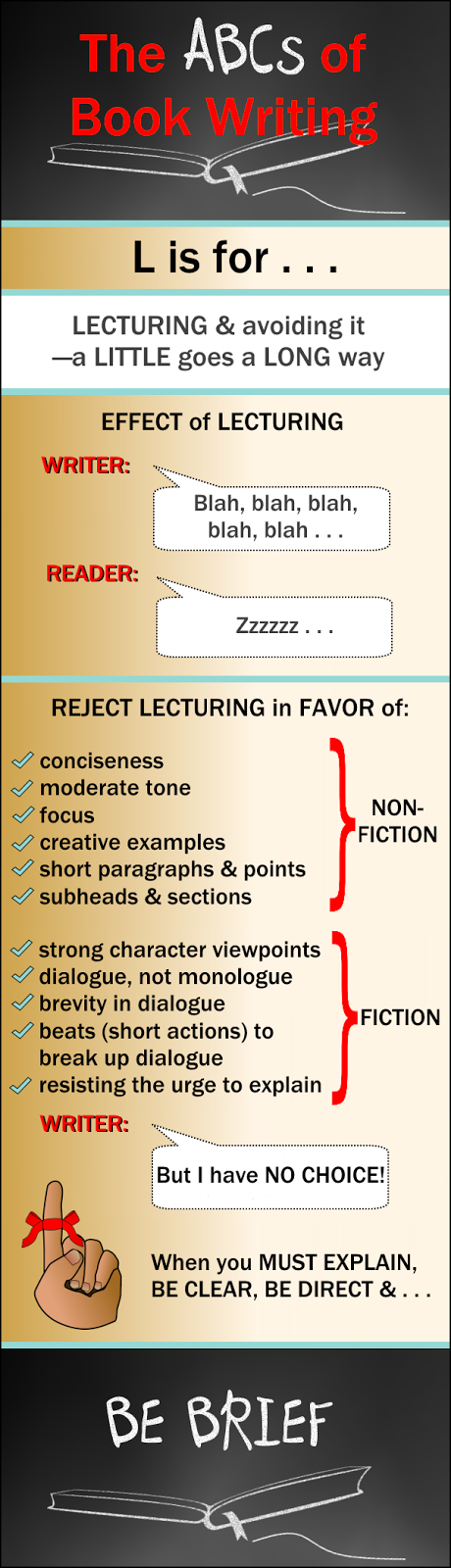
The ABCs of Book Writing: L is for LECTURING . . .

Infographic for Weekly Blog Series on Book Writing and Publishing
View larger image: Right click;
then left click "Open link in new
window." Zoom to 200% or
preferred size.
. . . and avoiding it—a LITTLE goes a LONG way.

What do you mean by lecturing when writing a book?

By lecturing, I mean dumping large quantities of dry facts or long-winded background information into your fiction or nonfiction with little regard for engaging the reader. The adverse effects of lecturing include:

- detracting from the interest of the main points or argument in nonfiction;
- halting the forward action of fiction; and, in all cases,
- boring or confusing the reader.

Is lecturing in a book ever OK?

Certainly—if you're a professor writing a guide called something like 25 Winning Lectures, then lecturing is not only OK, but a positive must. For most other kinds of books, instead of lapsing into lecture mode, try to find briefer and more readable ways to convey information.

Avoiding lecturing in nonfiction writing


In the writing of both creative and expository nonfiction, there are times when explanations or background information are necessary in order for the reader to understand what is going on. It is up to you as the author to ensure that your readers are suitably oriented and informed. But lecturing is by no means the only or most engaging way to do your job.

Tips for conveying information in nonfiction

 
—Be concise.

—Moderate your tone; don't harangue.

—Focus on the main points; don't digress.

—Don't quote at length from other books. This is boring and may violate fair use guidelines.

—Convey information through anecdotes, colorful examples, vignettes, or even recalled or imagined conversation.

—Keep paragraphs short: five or six sentences on average, interspersed with one- or two-sentence paragraphs for variety and emphasis.

—Where appropriate, introduce numbered or bulleted points.

—Use subheadings to break up lengthy topics into readable sections.

 Avoiding lecturing in fiction writing


Effective fiction is all about story and character. A novel or shorter fiction should never be a platform for the author to show off his or her erudition, voice opinions, or dish out copious amounts of explanations and background—however relevant such information might seem. Similarly, do not let your characters lecture either—whether they're expressing your views or their own.

Tips for writing fiction without lecturing the reader


—Do not overuse the omniscient author point of view—in other words, do not intrude yourself into the story. Develop strong character viewpoints and stay with them.

—Write character dialogue, not monologue.

—Keep all dialogue speech brief; do not let characters ramble on for two or more paragraphs.

—If conveying a lot of information through dialogue is necessary, then break up each speech into short, digestible chunks. Use "beats"—gestures, facial expressions, or short passages of action—to make the dialogue seem natural and to keep the story going forward.

—Resist the urge to explain. Let necessary information come out bit by bit as the story moves forward; reveal what the reader needs to know through the characters' actions and understanding.

The need to explain in fiction and nonfiction


Shakespeare on conciseness in writing
Shakespeare was to the point on brevity: watch
the video below . . .

There is a difference between the need to explain and the urge. More often than not, you may feel the latter, because explaining is less creatively taxing than devising more engaging ways to get your point across. In certain instances, however, a no-frills explanation may be the only option. This is the need to explain.

In both fiction and nonfiction, the need to explain something does not call for a full-blown lecture. Use your own feelings as a barometer. If you're boring yourself as you write, then the odds are that you're lecturing—and boring the reader too. Explain what and when you must, but never fail to practice lecture avoidance:

Be clear about the point you need to make. Get straight to it. Be brief.


Coming next week . . . "M is for MOMENTUM"

Saturday, May 27, 2017

The ABCs of Book Writing: K is for KNOWING what you don't know . . .

Infographic for Weekly Blog Series on Book Writing and Publishing: K is for KNOWING what you don't know
View larger image: Right click;
then left click "Open link in new
window." Zoom to 200% or
preferred size.
. . . and KNOWING to look it up.

Writers of expository nonfiction such as how-to and advice books generally do their research and get their facts straight. It is every bit as important for authors of creative nonfiction and fiction to look up what they cannot remember or imagine. Whatever you write, even if you are 99.9 percent certain that you know something, leave no room for doubt or error.

Look it up.

The importance of factual accuracy in expository writing, creative nonfiction, and fiction


It stands to reason that authors of textbooks, how-to guides, and advice books must aim for absolute factual accuracy, or their books would be worthless. A similar commitment to accuracy is also essential for writers of creative nonfiction and fiction. While most fiction readers appreciate an imaginative plot, many are also sticklers for correctness when it comes to the portrayal of real-life events, dates, geographic locations, professions, and specialized knowledge. If these readers find errors, they might be put off your writing for good.

For example, memoir writers need to verify the dates of their personal memories as well as events occurring in the world around them. Your memories are your own but they exist against a backdrop of personal chronology and historical events that must be accurately represented in order for your memoir to be engaging and convincing. Similarly, when writing fiction, you will disengage your readers if you don't ground your leaps of imagination in factual reality. If you are writing a police procedural mystery, for instance, you need to accurately represent how law enforcement really works. Even if you are writing an out-there futuristic techno-thriller, your story will have greatest impact if it takes off from a foundation of actual science and technology.

Why authors should research and fact-check


There are four strong reasons for authors of all kinds to do their utmost to write with factual accuracy:

—Meticulous research and concern for accuracy enhances your credibility.

—Avoidable errors can be off-putting to many readers; on the other hand, a reputation for accuracy can contribute to your reader retention. You want to attract readers, keep them, and avoid doing anything that might be a potential turnoff.

—Writing can be hard enough without your having to wrestle with a niggling feeling that you are not going the distance. Doing your research and fact-checking is a matter of professional pride.

—Research and fact-checking can be a source of new ideas or directions for either your current or future projects. Creativity and imagination may originate from within you, but both can be measurably enriched by research.

Doing your research: Sources of information for book authors


Internet


Today the first go-to source of information for most people is the Internet. Most users are aware that the reliability of sites and their information varies. For complex subjects, I therefore tend to use books by established authors rather than websites or blogs. But for basic information and fact-checking, nothing can beat the speed and convenience of the Internet.

To ensure that I am getting correct information or fact verification, I pick reliable sites such as Wikipedia and, where they exist, online versions of standard encyclopedias or dictionaries. When dealing with sites of lesser authority, I check at least three sources for the facts I am verifying. If they all agree, then I generally feel confident that the information is accurate. In case of discrepancies, I keep looking until a consensus emerges and I can eliminate the information that seems doubtful.

Personal library


Once upon a time, not so long ago actually, there was no Internet, and authors were largely dependent on libraries for research and fact-checking. In my case, I would make notes about facts that needed checking and bibliographic citations that I was missing. Then, every once in a while, I would take a break from writing and spend a day running up and down stairs in the university library stacks, filling in all the gaps in my information. This would generally take a whole day and was often exhausting.

To avoid these time-consuming and tiring excursions, like many authors, I found it useful to amass a personal library of reference works relating to the subjects I was writing about. Even today, despite the convenience of the Internet, I still value my personal library. Often, rather than going online, I find it is just as quick to pull a book off my own shelf and look up something in a source of proven reliability. My personal collection includes assorted dictionaries and style manuals, Oxford and Cambridge reference works on literature, book trade directories, and books on writing.

If you have the space and budget, you might explore the possibility of starting your own personalized at-home library. This can be a practical and satisfying complement to your writing activities.

The importance of books and digital research resources for book writers
Even in today's digital world, public libraries and
librarians remain among the best sources of information
and tips on effective research.
Public library


Most people have ready access to some sort of public library, whether municipal or university. These days many library holdings can be accessed online. Online library resources are a tremendous aid to research, as they provide the reliability of traditional information plus the convenience of the Internet.

Even if you have extensive access to online library holdings, don't entirely neglect paying the occasional in-person visit to a physical library. Librarians know how to find information with maximum efficiency and, often in minutes, can unearth facts and resources that you might take days to discover or altogether overlook.

The imperative of the authoritative author


Whether you rely on the Internet, compile your own book collection, or use public libraries and consult librarians, you owe it to your readers and yourself to be an author whose accuracy can be trusted. Know what you don't know. Get it right. Look it up.

Coming next week . . . "L is for LECTURING"