Showing posts with label nonfiction writing. Show all posts

Sunday, June 18, 2017

The ABCs of Book Writing: INTERMISSION

Blog series intermission till July
The series "The ABCs of Book Writing" is half done, with A to M completed last week. The series will resume in July as "Book Writing ABCs, with "N is for NEW." During this intermission period, go to https://www.facebook.com/HelpingYouGetPublished.FreelanceEditing/ for announcements and other posts on book writing and publishing.

For an overview of infographics and other visuals illustrating book writing from A to M, go to:
https://www.pinterest.com/helpingyougetpublished/the-abcs-of-book-writing-a-m/

Pinterest Overview of A to M

Sunday, June 11, 2017

The ABCs of Book Writing: M is for MOMENTUM . . .

Infographic for Weekly Blog Series on Book Writing and Publishing
View larger image: Right click;
then left click "Open link in new
window." Zoom to 200% or
preferred size.

. . . and MOVING the story forward.


Every book needs sustained forward momentum. Like a radio or TV show that suddenly has dead air, a book in which momentum halts sends a clear signal: something is wrong.

Momentum in fiction and creative nonfiction


To hold the reader’s interest, all novels must create and maintain a sense of the plot going forward. In a thriller, this momentum is typically very fast. In other kinds of novels the pace may be slower, more like real life. But the forward momentum must be there nonetheless, or the reader feels no need to read on. Creative nonfiction must similarly establish and maintain momentum in order to attract and keep the reader's attention.

Sustaining momentum in fiction and creative nonfiction


For novels, novellas, and stories:

—Cultivate conflict and problems. Stories are propelled by the conflicts and problems that characters encounter and resolve. Remove all conflict and you have no plot; fail to sustain conflict and you get a plot that stops and starts. Instead, constantly thrust the character into scenes where the character must confront conflicts, take action, and solve problems—thus changing, growing, furthering the plot, and always moving the story forward.

—Keep explanatory description of settings, people's physical appearance, and emotions to a necessary minimum. Never lecture. Show, don't tell.

—Avoid long flashbacks. Integrate flashback information bit by bit into the main action of the story.

—Avoid detailed backstory. As with flashbacks, integrate the necessary background information into the main action.

For memoirs, biographies, popular histories, and true crime:

Use any or all of the strategies noted above to ensure that your readers stay engaged. Creative nonfiction typically employs many, if not all, of the narrative techniques of fiction. What I have said with respect to fiction writing therefore applies to your work of creative nonfiction. While you may be able to take greater liberties with description, flashbacks, and backstory than you would with fiction writing, the need to sustain forward momentum always remains.

Momentum in expository nonfiction


Expository nonfiction does not have a story in the same way as fiction or creative nonfiction. But books specifically designed to explain and instruct must still convey to the reader a sense of forward thrust, of constantly moving toward any or all of the following:

-conclusion of an argument
-solution to a problem
-benefit for the reader
-specific action the reader can take
-fresh insight
-new skill or knowledge

If the nonfiction book appears to lack such momentum and direction, readers will disengage in the same way that they would from a novel that grinds to a halt.

Sustaining momentum in expository nonfiction


For how-to, self-help, and motivational books; textbooks; and academic and technical works:

Remember the reader
Making a habit of putting reader understanding before a
display of your own knowledge will automatically help
sustain forward momentum.
—Stay focused on the book's ultimate objective. Avoid digressing.

—Be concise. Avoid lecturing.

—Be clear. Don't obfuscate by writing in circles around the subject.

—Remember the reader. Always prioritize reader understanding over showing off your own expertise or erudition.


Keep moving, keep readers


Forward momentum equals reader engagement
Daisy, the Helping You Get Published mascot, demonstrates
forward momentum and reader engagement.
All readers know the power of those books that compel us to keep turning the pages to find out what comes next. Momentum is the source of this power. Without sustained momentum, you not only lose writing power but you lose readers. Forward momentum is at the heart of reader engagement. Successful writing is that simple—and that challenging.


INTERMISSION: The ABCs of Book Writing will resume in October
with “N is for NEW.” Announcements at: https://www.facebook.com/HelpingYouGetPublished.FreelanceEditing/

Saturday, June 3, 2017

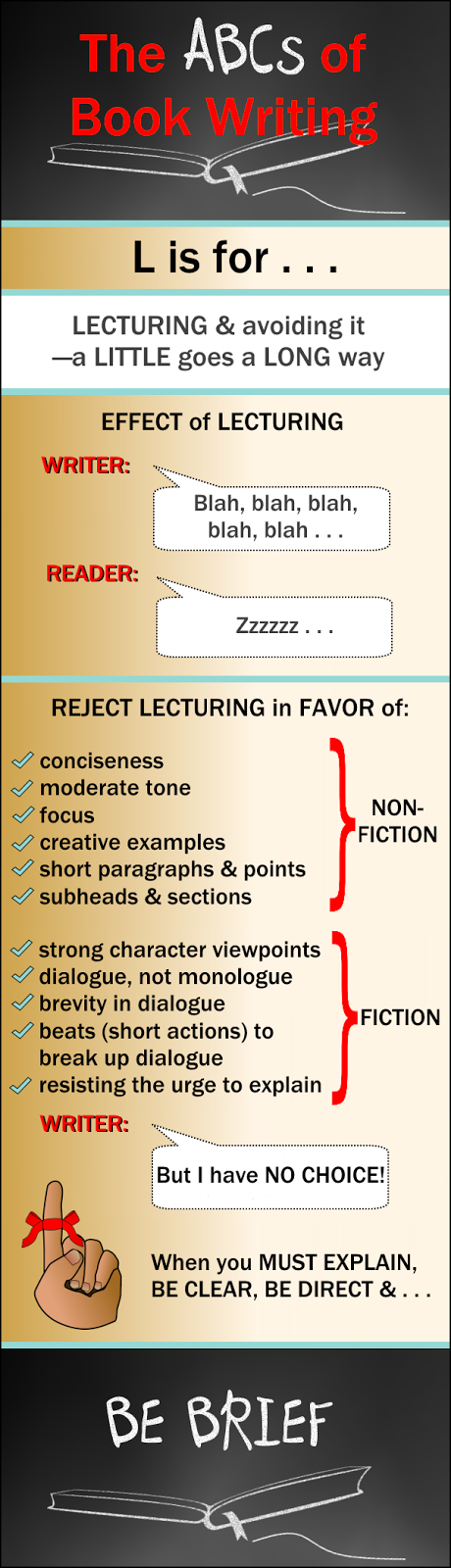
The ABCs of Book Writing: L is for LECTURING . . .

Infographic for Weekly Blog Series on Book Writing and Publishing
View larger image: Right click;
then left click "Open link in new
window." Zoom to 200% or
preferred size.
. . . and avoiding it—a LITTLE goes a LONG way.

What do you mean by lecturing when writing a book?

By lecturing, I mean dumping large quantities of dry facts or long-winded background information into your fiction or nonfiction with little regard for engaging the reader. The adverse effects of lecturing include:

- detracting from the interest of the main points or argument in nonfiction;
- halting the forward action of fiction; and, in all cases,
- boring or confusing the reader.

Is lecturing in a book ever OK?

Certainly—if you're a professor writing a guide called something like 25 Winning Lectures, then lecturing is not only OK, but a positive must. For most other kinds of books, instead of lapsing into lecture mode, try to find briefer and more readable ways to convey information.

Avoiding lecturing in nonfiction writing


In the writing of both creative and expository nonfiction, there are times when explanations or background information are necessary in order for the reader to understand what is going on. It is up to you as the author to ensure that your readers are suitably oriented and informed. But lecturing is by no means the only or most engaging way to do your job.

Tips for conveying information in nonfiction

 
—Be concise.

—Moderate your tone; don't harangue.

—Focus on the main points; don't digress.

—Don't quote at length from other books. This is boring and may violate fair use guidelines.

—Convey information through anecdotes, colorful examples, vignettes, or even recalled or imagined conversation.

—Keep paragraphs short: five or six sentences on average, interspersed with one- or two-sentence paragraphs for variety and emphasis.

—Where appropriate, introduce numbered or bulleted points.

—Use subheadings to break up lengthy topics into readable sections.

 Avoiding lecturing in fiction writing


Effective fiction is all about story and character. A novel or shorter fiction should never be a platform for the author to show off his or her erudition, voice opinions, or dish out copious amounts of explanations and background—however relevant such information might seem. Similarly, do not let your characters lecture either—whether they're expressing your views or their own.

Tips for writing fiction without lecturing the reader


—Do not overuse the omniscient author point of view—in other words, do not intrude yourself into the story. Develop strong character viewpoints and stay with them.

—Write character dialogue, not monologue.

—Keep all dialogue speech brief; do not let characters ramble on for two or more paragraphs.

—If conveying a lot of information through dialogue is necessary, then break up each speech into short, digestible chunks. Use "beats"—gestures, facial expressions, or short passages of action—to make the dialogue seem natural and to keep the story going forward.

—Resist the urge to explain. Let necessary information come out bit by bit as the story moves forward; reveal what the reader needs to know through the characters' actions and understanding.

The need to explain in fiction and nonfiction


Shakespeare on conciseness in writing
Shakespeare was to the point on brevity: watch
the video below . . .

There is a difference between the need to explain and the urge. More often than not, you may feel the latter, because explaining is less creatively taxing than devising more engaging ways to get your point across. In certain instances, however, a no-frills explanation may be the only option. This is the need to explain.

In both fiction and nonfiction, the need to explain something does not call for a full-blown lecture. Use your own feelings as a barometer. If you're boring yourself as you write, then the odds are that you're lecturing—and boring the reader too. Explain what and when you must, but never fail to practice lecture avoidance:

Be clear about the point you need to make. Get straight to it. Be brief.


Coming next week . . . "M is for MOMENTUM"

Sunday, May 21, 2017

The ABCs of Book Writing: J is for JUST write . . .

Infographic for Weekly Blog Series on Book Writing and Publishing: J is for JUST write
View larger image: Right click;
then left click "Open link in new
window." Zoom to 200% or
preferred size.
. . . and JUST why you should.

In the real world of professional authorship, the bottom line is: writers write. Over the course of a career some authors will produce dozens, perhaps even hundreds, of books, articles, and reviews. Others may produce only a handful and build a career by combining writing with speaking, teaching, or consulting. How prolific you are depends on a number of personal and professional factors—for example: whether or not you have a day job, your health and energy, your family and domestic obligations, and the type of writing you do. Regardless of your individual situation, what you don't want to be is a one-book author.

Why writers must keep writing


There are four basic reasons why there is no downside to your being as prolific a writer as you can manage to be:

1. Writers must keep writing for the obvious reason that this is the only way to produce a sufficient amount of work to reach others. The more you produce, the more likely you are to find markets and draw readers.

2. Writing continuously is the only way to significantly grow as a writer. In the course of producing one book, you may gather momentum and hone some skills. But without continuing to write, it is hard to imagine maintaining your craft, let alone improving on it.

3. The more you write, the more likely you are to be successfully published. It is difficult to break into the market as a first-time book author with absolutely no credentials. Agents, publishers, and readers will be swayed in your favor if you have some writing credentials, such as book reviews, journal or magazine articles, or anthology contributions. Now that publishing credentials can be obtained through both print and digital sources, it's hard to justify wanting to be a book author while remaining totally unpublished.

4. To keep on writing is to be a professional. Even if you have just finished a magnum opus, you have no excuse to hang up the quill pen or power down your computer. If you work hard at your manuscript and persevere with querying agents and publishers, or with marketing your self-published book, your work will eventually attract someone who can take you to the next level. But odds are, that someone will not only value prior writing credentials but will also want you at least to have a second book in progress.

Strategies to keep you writing


Ideally, while you are working on one book—presumably your main project—you should be writing something else as while. If this is absolutely not possible for you, then once the main project is completed, immediately begin the next book or some other writing project, preferably one related to your newly completed book.

Strategies that will keep you writing can be as many and as varied as writers themselves. Here are a few for you to try and to adapt to suit yourself and your situation:

Strategies to keep writing
—While writing one book, research, plan, make notes on, and write snippets of the next book.

—Seek out book reviewing opportunities. Start but don't stop with Amazon, Smashwords, and Goodreads.

—While writing one book, work on another in a different but related genre, to keep you fresh in both. Examples of possible pairings: science fiction/popular science; contemporary romance/romantic suspense; detective fiction/true crime; popular history/historical fiction; cozy mystery/period mystery.

—Write articles or short stories related to your current book in progress; write and send out queries for these.

—Start, and work hard at, a blog related to your book.

—Look for related blogs to contribute to as a guest.

—If your book is part of a series, make notes on, or write drafts of, later books in the series.

—Just for fun, write fan fiction. It could grow your author platform.

—If all else fails, write journal or diary entries. These will not likely be publication ready anytime soon, but maybe someday . . .

Just keep writing


However you choose to do it, stay continuously involved in the writing process. Some of us must devote time and energy to day jobs, and we all need downtime. But succeeding as a book author means never entirely walking away from writing, whether it's a book you're working on or something—anything—else that qualifies as potentially publishable written work.

Writers write.

Coming next week . . . "K is for KNOWING what you don't know"

Friday, May 12, 2017

The ABCs of Book Writing: I is for INTERTEXTUALITY . . .

Infographic for Weekly Blog Series on Book Writing and Publishing: I is for INTERTEXTUALITY
View larger image: Right click;
then left click "Open link in new
window." Zoom to 200% or
preferred size.
. . . and enhancing your own IDEAS.

What is intertextuality? And why should I know about it?


Intertextuality is a term used in literary theory to designate the diverse ways that any literary text inevitably refers to other texts, both past and contemporary. These other texts may include novels, nonfiction books, and other written works. The text in intertextuality also encompasses other forms of artistic and cultural expression:

—movies
—music
—television
—ideas and beliefs
—symbols
—sayings, conventions, and oral traditions

Intertextuality reflects the reality that culture is a way of life. It is therefore inevitable that a writer's cultural experience and community will find direct or indirect expression in his or her own writing. Intertextuality is important because recognizing and using it effectively can add to your personal stock of ideas, and enrich your writing.

For an overview of intertextuality, watch the video at the bottom of this post.

Intertextuality in fiction and nonfiction books


There are many ways that one text may refer to another. Such references may be direct or indirect, conscious or unconscious on the part of the author. In written works, they may be found anywhere from commercial nonfiction to literary and genre fiction, and might include the following:

—quotation
—allusion
—adaptation
—synthesis
—parody
—structural parallelism
—imitation

Examples of intertextuality in literature and popular culture


Examples of intertextuality from the literary canon include Joseph Conrad's Heart of Darkness, which refers to Dante's Inferno, and his later novel Victory, drawn from Shakespeare's The Tempest. Among the best-known literary examples of intertextuality is James Joyce's Ulysses, a modern retelling of Homer's Odyssey.

Examples of intertextuality in TV & movies
Today's popular culture is also rich in intertextuality. The long-running comedy series The Big Bang Theory combines fresh, clever writing with extensive intertextual references to earlier sitcoms, Star Trek, Star Wars, various action-hero movies, comic books, and popular science—to name just some examples. In film, notable intertextual variations on earlier plots include Sleepless in Seattle (1993), which uses quotes, clips, and music from An Affair to Remember (1957), and Bridget Jones's Diary (2001), a millennial adaptation of Jane Austen's Pride and Prejudice (1813).

The power and pitfalls of intertextuality in writing


Examples from literature and popular culture show that, used with awareness and innovativeness, intertextuality can be a powerful creative tool. Just the introduction of a short but apt quote can add an extra level of artistry and meaning to your writing. Beware, however, of overdoing your intertextual references and adaptations, or you might run the risk of having your work dismissed as too derivative. Falling back on hackneyed writing, discussed previously, is another kind of intertextual faux pas. Worst of all, for ethical as well as artistic reasons, is plagiarism, an extreme and always unacceptable form of intertextuality.

If you are unsure of what constitutes intertextual innovation, freshness of expression, and fair use, err on the side of minimalism: a pithy quote, passing allusion, or new twist on an old idea. When handled with deftness and discretion, intertextuality adds dimension and interest to your writing. 

Sources for this post: M. H. Abrams, A Glossary of Literary Terms, 5th ed. (1988); Chris Baldick, The Concise Oxford Dictionary of Literary Terms (1990); and David Lodge, The Art of Fiction (1992).


Coming next week . . . "J is for JUST write"

Saturday, April 29, 2017

The ABCs of Book Writing: H is for HACKNEYED writing . . .

Infographic for Weekly Blog Series on Book Writing and Publishing:  H is for HACKNEYED writing
View larger image: Right click;
then left click "Open link in new
window." Zoom to 200% or
preferred size.
. . . and HOW to break its HABITS.

Hackneyed writing can afflict most writers from time to time. The challenge of effective writing is to become aware of the habits associated with hackneyed writing, and to do what is necessary to break them. The more you succumb to the lure of hackneyed writing, the more likely you are to create a tedious and unsaleable manuscript.

What is hackneyed writing?


Hackneyed writing is the repeated falling back on words, phrases, or narrative techniques that were once fresh but have now suffered from decades, or even centuries, of use, reuse, and overuse. The reason that hackneyed writing persists is because it comes easily to us. When we are writing, and our heads are full of points of argument, plot twists, lines of dialogue, and all the other ideas and images that we feel urgency to express, what often come first to mind are the clichés and familiar narrative techniques of hackneyed writing.

Hackneyed writing habits


The following are common habits associated with hackneyed writing:

1. Making outworn comparisons


busy as a bee, fat as a pig, hot as hell, light as a feathereasy as pie . . .

Break the habit by creating original similes, metaphors, or other images: She launched herself into a flurry of activity. His belt buckle was almost obscured by his stomach.


2. Relying on tired turns of phrase*


-that said/that having been said/having said that (try but, however, or even so)
-sooner rather than later (try immediate/immediately, prompt/promptly, without delay, or plain old soon)
-few and far between (try rare)
-in this day and age (try these days, now, nowadays, today)
-by leaps and bounds (specify the quantity: improved by 20 percent, tripled, grew by eight times the rate of last year)
-a good time was had by all (saying almost anything would be better than this; or just record the events and leave it to the reader to conclude whether it was enjoyable or otherwise)
-risked life and limb (risked his/her life)
-for all intents and purposes (can be deleted in most contexts)
-at the end of the day (ditto)
-it goes without saying/needless to say (delete these phrases; any point they introduced should be deleted or rewritten: If it goes without saying, why say it at all?)

Break the habit by deleting or using substitutes, as in the parenthetical suggestions above.


3. Overusing -ly adverbs, especially in dialogue sentences


 "I hate studying," Joe said angrily.

4. Expressing speakers' feelings with animal noises


"Stop that," he snarled. "I'd like that," she cooed. "Get away from me," she hissed. "I hate studying," Joe growled.

Break these two habits by choosing precise, expressive nouns and verbs to show feelings and create images around the dialogue: "I'd like that," she said, moving so close that he could smell the citrus scent of her shampoo. "I hate studying," Joe said and slammed the textbook shut.


5. Constantly reversing the construction of dialogue sentences 


"I hate studying," said Joe.
"Me too," agreed Mary. "Such a bore," said she.

Break the habit by routinely choosing the subject-verb construction in dialogue sentences:
"I hate studying," Joe said.
"Me too," Mary agreed. "Such a bore," she said.

While the subject-verb construction is the best choice for most dialogue sentences, there are some contexts in which the reverse construction is not only acceptable, but preferable. For example: "Such a bore," said Mary, who drove home the point with an elaborate roll of her eyes. (Rather than: "Such a bore," Mary, who drove home the point with an elaborate roll of her eyes, said.)

Dog sleeping on book
Outworn language and narrative style bore the reader.

6. Using too many substitutes for said


"Mary," he remarked, "I didn't know you were still here."
"I came back to rest for a few minutes," she replied.
"Can I get you anything?" he asked.
She shook her head. "No, I'm fine," she insisted.

Break the habit by using said or nothing at all:

"Mary," he said, "I didn't know you were still here."
"I came back to rest for a few minutes."
"Can I get you anything?"
She shook her head. "No, I'm fine."


7. Being an intrusive author

If you are writing a how-to or self-help book, it is appropriate to address the reader directly and possibly to include illustrative examples based on your own experience, perceptions, or expertise. Fiction, however, is another matter, and readers will not welcome the overbearing, omniscient author who indulges in the following kinds of intrusion:

As Mary enters the dark pathway you might think you know what happens next but, in fact, you are in for a surprise. Little did she know that her life was about to be changed forever. She was so worried that she did not feel the first drops of rain on her head and failed to see the murderer lurking behind a tree. She had no idea that disaster awaited her.

Break the habit by never stopping the story to address the reader directly. And do not tell readers what the character does not know or feel. Stay in the background and unfold the story through one or more strong character viewpoints:

As she entered the dark pathway, Mary's unease took control. Why do I feel like my life is about to change forever? she thought.

Sudden cold drops of rain on her head startled her into awareness of her surroundings. She glimpsed what looked like a shadowy figure trying to hide behind a tree, but dismissed this as a figment of her overactive imagination. Still, she could not deny that her fear was now as real and as cold as the falling rain.

Earning your cliché


Is there ever a time to give in to the habits of hackneyed writing? Some stylists argue that you can earn your clichés. That is, after a long passage of writing in your own unique voice, you might be able to make a point or create drama by deploying a cliché. Sometimes clichés can become ironic or otherwise effective in a new, well-conceived context.

If, however, you have any doubt about whether you’ve earned your cliché, bypass it and reach for a fresh turn of phrase or up-to-date narrative technique. Odds are, this effort will serve you better than even the most judicious falling back on the stock figures of speech and bygone narrative tropes of hackneyed writing. Whenever you can, turn the outdated into the original.

*The list of tired phrases includes examples from Judy Birnberg, WordThoughts (blog), March 14, 2017, https://writejudi.wordpress.com/tag/list-of-trite-expressions/; and Mark Evans, Grumpmeister (blog), January 14 and August 7, 2012, https://grumpmeister.wordpress.com/category/hackneyed-phrases/. For additional examples, see Brian A. Klems, The Writer's Dig (blog), August 15, 2012, http://www.writersdigest.com/online-editor/12-cliches-all-writers-should-avoid.

Coming next week . . . "I is for INTERTEXTUALITY"

Tuesday, April 11, 2017

The ABCs of Book Writing: E is for EMAIL . . .

Infographic for Weekly Blog Series on Book Writing and Publishing:  E is for EMAIL
View larger image: Right click;
then left click "Open link in new
window." Zoom to 200% or
preferred size.

. . . and ERRORS in writing.


Email, a relative newcomer to the world of written communication, is now deeply embedded into our daily lives. And why not? It's mostly quick and easy, and it doesn't demand the time-consuming formalities of old fashioned letter writing.

The problem is that what is acceptable in email writing style, even colorful or amusing, can be downright annoying in a book manuscript—annoying to the point of being a deal breaker. Agents and publishers will take one look at a manuscript riddled with the typical errors of email writing and think: "Too much editing required." In today's competitive book trade, that's all you need for a rejection. If you are self-publishing, your editing costs will soar if you do not self-edit the email style out of  your book manuscript. If you choose to bypass editing, some readers might not mind your cool, free-wheeling style, but plenty of others hold book authors to a higher standard. Can you afford to lose these potential readers?

Video still of "Email Writing Syndrome"
Email Writing Syndrome.
Watch the video below . . .
A few years ago, I noticed the extent to which email writing mannerisms and errors were infecting book writing and coined a tongue-in-cheek term for this contemporary malady: "email writing syndrome." You can read all about the symptoms and find out my suggested cures here. Alternatively, watch the video version at the end of this blog post.

How to recognize email writing style


The main signs of email writing style are:

Inattention to paragraphing. Paragraphs run on despite topic changes; alternatively, there are too many one-sentence paragraphs, creating a choppy effect.

Use of hyphens instead of conventional punctuation. Hyphens have specific uses, for example in compound words and in some prefixes and suffixes. They are not sentence punctuation.

Overuse of sentence fragments. Incomplete thoughts presented as sentences have their place and can create drama or emphasis. But too many sentence fragments lead to disjointedness and impaired readability.

Run-on sentences. Connecting several complete sentences or thoughts together, separated only by commas, has its uses in dialogue, as it shows how people often talk. This dialogue technique has made its way into the chatty style of email but needs to be used with restraint in other forms of writing.

Ellipsis gone wild. She paused..............................then tried again, without success, to tell her story............................................

Use of capitalization for emphasis. This KIND of EMPHASIS is acceptable in design, advertising, and some headlines but generally NOT appropriate in book writing.

Overuse of exclamation marks. Need I say more?!!!!!

Self-editing email style


Here are the basics for editing email style out of your book manuscript, and replacing it with a dash of elegance:

Break long paragraphs into shorter ones. Use no more than twelve sentences per paragraph in most kinds of writing. Use occasional one- or two-sentence paragraphs for dramatic effect or extra emphasis.

Use hyphens for compound words and some prefixes and suffixes. Examples include kilowatt-hour, mass-produced, co-op, anti-inflammatory, university-wide, and so on. Consult Merriam-Webster's Collegiate Dictionary for authoritative help. In sentence constructions, replace hyphens with commas, semicolons, periods, or em dashes (—), which are sometimes typed as two hyphens--as shown here.

Use sentence fragments sparingly. The fragment is a device to add compelling, not distracting, effect to your writing. A device—not a complete writing strategy.

Break up run-on sentences. Insert periods to make shorter sentences, or use conjunctions and semicolons to separate thoughts within a sentence. Wrong: The dog was black, the cat was white. Right: The dog was black. The cat was white. / The dog was black and the cat was white. / The dog was black; the cat was white.

Use ellipsis properly. Ellipsis is signified by three points, with a space between each, used with or without added punctuation. Ellipsis can indicate speech trailing off in dialogue:  "What . . . ?" "I don't . . ."  It also indicates time elapsed and/or repetitive action: They walked and walked. . . . In advertising and design it can be an attractive substitute for a colon or em dash.

Avoid using capitals for emphasis and keep exclamation marks to a minimum. Create emphasis through language and imagery, punctuation, cadence, and occasional use of italics.

With email style eliminated or reduced, your true authorial voice has a chance to be heard.


Coming next week . . . "F is for FORMATTING"

Saturday, April 1, 2017

The ABCs of Book Writing: D is for DISCIPLINE . . .

Infographic for Weekly Blog Series on Book Writing and Publishing: D is for DISCIPLINE
View larger image: Right click;
then left click "Open link in new
window." Zoom to 200% or
preferred size.
. . . and DEVELOPING it now.

"Apply seat of pants to seat of chair." Today, the old tried and true formula for disciplined writing might be extended to include: "Park feet in front of standing desk"; or: "Tap finger on touch screen"; or: "Direct voice to speech-recognition software." The trouble is that all such admonitions are more easily uttered than acted upon.

However you choose to write, finding the time and discipline to do so is a challenge. Life—in particular, the day job—tends to get in the way of your best-laid plans to establish a writing regimen. Apart from the imperative to work and pay bills, buy groceries, and keep a roof over your head, even writers need to spend time with friends and family, get some exercise and fresh air, sleep a few hours, and just chill out.

So when do you write? 

Choosing a time of day to write


Your choice of a time, or times, to write will depend on a number of variables: for example, whether you are a morning person or a night owl, the quiet or chaos in your household, and the demands of your employment. Most writers that I know either get up early and write before going to work, or they write in the evening after dinner. A few energetic types manage to write both early and late in the day. Those whose "day jobs" are at night, or who work changing shifts, have to create their own versions of the before-work and/or before-bed writing sessions. Some particularly motivated multitaskers may also manage to get in some extra writing time during lulls in the workplace, coffee breaks, and lunch hours.

The writing session 


How long should each writing session be?


For significant progress, plan for sessions of at least an hour each; more ideally, two to three hours.  On a good day, you can produce a reasonable quota in an hour. On other occasions, the words do not come so readily and you will need two or three hours to grind out what might not even amount to a minimum daily quota. Don't worry unduly about the less productive sessions. Over time, the good and not-so-good days average out, and the slow sessions, while frustrating, are nonetheless part of an overall forward progression.

Writing discipline: "Apply seat of pants to seat of chair."

How often should you write?


Obviously, the more days per week that you can manage to write, the better. But if you're working at your employment twenty to forty or more hours a week, you are unlikely to be able to write daily or even every other day. The good news is that you don't have to write that often. In fact, to produce a book-length manuscript in reasonable time, you really only have to write one to three hours three times a week, or some equivalent of that. Here's why:

Word count: The mathematics of writing a book


All you need to write at each session is a comparatively modest 550 words—approximately two double-spaced pages. On a good day, you will do this in an hour or less. On those other days, you might well need a two- to three-hour session. Either way, if you produce just 550 words three times a week, that's a weekly total of 1650 words. Multiply that by the 52 weeks in a year—and there you have it: a finished draft of 85,800 words. This is an acceptable length for all but a few specialty subgenres (some of which may even require fewer words)—and you can congratulate yourself on having written a book in a year.

Typically, as writing progresses, momentum grows, and you could increasingly surpass your session quota. If so, then you would in fact produce an entire book manuscript in a matter of months. When you get the hang of it, disciplined writing doesn't require as much discipline as you once might have thought!

Coming next week . . . "E is for EMAIL"

Saturday, March 25, 2017

The ABCs of Book Writing: C is for CHAPTERS . . .

Infographic for Weekly Blog Series on Book Writing and Publishing: C is for CHAPTERS
View larger image: Right click;
then left click "Open link in new
window." Zoom to 200% or
preferred size.

. . . and CREATING a book structure.


The most common and important unit of division in most kinds of books is the chapter. Books may be divided solely by chapters; or they may be divided by chapters that are further divided into sections or scenes. In many books, chapters are also grouped in parts or even in books within the main book. For artistic or informational reasons, a few books consist only of sections or parts or some other divisions that may or may not function as, or resemble, chapters. I will refer mainly to chapters in this discussion, but what is said will in most cases apply equally to books structured by other kinds of divisions.

Designating chapters 


Nonfiction works typically use numbers and titles to designate chapters. Novelists these days usually opt for numbers without titles or numbers each prefaced by the word chapter. Some authors of fiction have reinstated an earlier practice of both numbering and naming chapters. Some works of fiction and nonfiction may have chapter titles without numbers. Before writing, you may wish to come up with working titles (which can be changed as needed in the course of writing) or simply think of your chapters as numbered units.

Creating a working book structure 


Start with a basic concept of the ordering of your book's chapters (or groups of chapters or episodes within chapters). Then you sort your notes and thoughts accordingly. You may accumulate and conceive these in any order, which tends to be how the creative process works. But then you organize them according to your planned book structure.

I use a combination of physical file folders and computer folders to put my ideas in, with each folder labelled by chapter number and working title. Very short chapters may be grouped into parts, similarly labelled by number and/or by working title or main theme. For note taking and idea jotting, small-sized notepaper, recipe-type cards, and short computer documents/texts are the best choices for easy sorting and reference. Give each note or related group of notes a title or label so you know at a glance what it is about. If you go in for too-lengthy notes without clear labels, you will find yourself in the predicament that I described in "B is for BLOCK"—overwhelmed and blocked by too much text as you struggle to find the idea or information that you need in order to keep writing. Your chapter file folders, each containing individual notes and ideas, constitute your book's working structure. When I come to write a specific chapter, I pull the file with my labelled notes and ideas, sort them into what seems to be a sensible order—by theme, chronology or plot—and write away.

Your chapter files and working book structure keep you oriented as you write and defend against writer's block. Your organizational system allows you to add thoughts quickly, file them without getting confused, bogged down, and then blocked. You can even write out of numerical chapter order to stay fresh and productive when you perhaps are struggling or bored with one chapter. Leave it for a while and start another, and then go back and forth, if you wish. Write the whole book out of order if that pleases you. You are free to do so because, with the aid of your organizational system, you carry the whole book structure in your head, with each chapter's specific notes, ideas, plot twists, episodes, character sketches, research, sources, and quotes organized for reference whenever you need them.

To outline, or not . . .


Book structure need not be carved in stone
Your ideas may be monumental,
but they are not cast in metal or
carved in stone. The same should 
be true of your organizational
system and book structure.
You might think of your organizational system as a kind of outline. There remains the question of a more formalized outline—that is: Do you need a written-out, detailed book outline in addition to your organizational system? Seasoned writers are divided on the value of such an outline.

I personally work from my sense of the overall structure in conjunction with my files and have not found a need to spend creative energy devising an additional outline. If you, however, feel that you need a detailed outline for writing confidence or memory jogging, then so be it. But don't allow the outline to constrain you and limit the introduction of spur-of-the-moment ideas that could make a crucial difference to your book and its success. Think of your outline not as cast in bronze or chiseled in granite. Think of it instead as something changeable and fluid—like the weather, or a river with many streams that might bear exploring.

Flexible book structure and chapter organization


It is also advisable to remember that your working book structure is just that—a work in progress, and subject to rethinking and reordering. You can have a reasonable working structure from the outset, but be prepared for some surprises as the writing progresses. For instance, you might discover that what you thought would be a great chapter 4 is too short to stand alone and should in fact be a section of chapter 3. On the other hand, your imagined, perfect chapter 10 is now going on and on, and really needs to be divided into two, or even three, chapters. It all becomes clear as you write, create, and re-create.

The point to remember is that planning and organizing to write, and actually writing, are related but different activities. A good working structure will ease your writing and go a long way toward eliminating block. But this structure must be flexible enough to shift as your ideas shift. Like creativity and writing, planning and organizing should be dynamic processes that have constant potential for change and improvement. Otherwise, your organizational system is not worth the price of file folders.

Organization creates structure, enhances clarity, and sustains focus. A flexible structure promotes ongoing inspiration.

Coming next week . . . "D is for DISCIPLINE"

Saturday, March 18, 2017

The ABCs of Book Writing: B is for BLOCK, writer's . . .

View larger image: Right click;
then left click "Open link in new
window." Zoom to 200% or
preferred size.
 . . . and BEATING it.

Writer's block is the fear of almost every writer and, from time to time, the all-too-real predicament of many. When you find yourself paralyzed by a block, it is arguably one of the most miserable of psychological states that any creative person can encounter. It might be some consolation to hear that such prolific writers as Joseph Conrad, Charles Dickens, Graham Greene, Ernest Hemingway, Leo Tolstoy, and Virginia Woolf also, on occasion, suffered from writer's block (though they might not have used those exact words to describe the affliction). But knowing that your pain is hardly unique does nothing to relieve your immediate discomfort.

Writing is in many ways a highly individualized act of creativity. At the same time, there can be commonalities that we all share. Here, then, is what I know, and have experienced firsthand, when it comes to writer's block and how to beat it. My solutions may not be the complete or ultimate ones for you, but I promise that they will help and give you enough relief that the block won't beat you and pummel your writing career into the ground.

I have found that there are two main kinds of writer's block:

1. Basic writer's block


This kind of block has two variations. The first is a scenario something like this: You have been writing, it has been going well, and with some number of words or scenes or even chapters now written, you feel pretty good and decide to take a break. But not just any break—your plan is to reread all or some of what you have written, in order to pat yourself on the back for a job well done and fuel your fire to keep on writing. That's when the unforeseen happens: You hate what you've written. The thoughts might be fine but the wording is terrible. This isn't your annoying inner critic speaking but your actual professional instincts signalling the truth. This writing will not play in Peoria, let alone engage readers or publishers.

So you dig in and start some revision work, but this does not produce the desired result—the words are flopping like dying fish on the page or screen. So you try again . . . and again . . . until you are blocked.

There are three typical ways to resolve this unhappy situation:

  • Walk away for a while; have lunch; vacuum something; go outside and rake leaves; or, if it's getting late at night, go to bed. As the biographer Elizabeth Longford observed in her memoir, The Pebbled Shore, "Writing . . . problems that have appeared insoluble at midnight have a way of smoothly solving themselves at midday."

  • Leave the problem passage as is, carry on with the book, and fix the trouble spots during later revisions. When you have a first draft completed, you will benefit from a broader perspective on the whole book than what you had earlier. Now that it is time for revisions, you will usually find that fixing once-recalcitrant writing is straightforward. What was all the fuss about? you now wonder.

  • Hire an editor. A good editor can work wonders of clarity and rewording. But consider this a last resort—you will be a better writer if you master self-editing.

For some other ideas on addressing the basic block, see http://www.writersdigest.com/editor-blogs/guide-to-literary-agents/7-ways-to-overcome-writers-block.

A variation on this sort of block is one that I have often experienced, and it typically involves short passages, such as a sentence or two, or at most an entire paragraph. It happens like this: You're writing; it's going well; and now you have reached a point where you know exactly what sentence or paragraph you need to write next. You write it and it either seems not to make sense or just sounds bad. So you tinker a bit and it's still not working. Following Einstein's theory of insanity, you keep fiddling—for hours, maybe the rest of the day and on into the next . . .

Occasionally, after much obsessive rewriting, I have gotten such a passage right, but here's what I have found to be true nine times out of ten: If it's that hard to write, it doesn't need to be there. Throw it out! You'll find yourself able to carry on without headaches or harm to your overall story or argument. If you can't bear to delete such misfit passages, then save them in a separate computer file, just in case you find a place for them later. You probably won't, but whatever makes you feel better . . .

2. Big, bad writer's block


This truly worst kind of block typically happens when you start writing your book or when you are not far into it. Occasionally, it might also occur after you have written a significant amount but have, for some reason, been away from the project for a lengthy period of time.

You are at your desk or whatever is your preferred writing space. You have made time to write. The world is quiet around you. Your pen is poised over paper, or your fingers over keyboard. And then you can't write—you simply don't know what to write. You thought you did but now, at the moment of truth, words fail. You get up and pace, get a glass of water, and sit back down to try again. Same result. Z is for ZERO.

If you are writing nonfiction, this kind of block is sometimes due to a lack of information about some part of your subject. The usual solution is to do a little more research, or even merely to look something up in a reference book or online source, and with the gap in your knowledge filled, you are now able to write. In fiction writing, the comparable problem can be the result of a previously unrecognized missing piece, or wrong turn, in your plot. The best solution is to stop and think it through, discover the missing piece, or find a new turn in this part of your story line.

Writer's block is often the result of too much, rather than
too little—so many notes and ideas that when it's
time to write, you're overwhelmed and get blocked.
In my experience working with new authors, the more common cause of the big, bad block is not a shortage of ideas, but too many of them. In fact, your head is spinning with ideas but not a one wants to spin into anything resembling a coherent sentence. Fortunately, this kind of block only happened once to me, and I learned a lot from it.

I was about to start writing my master's thesis. I had already published shorter pieces, such as journal and magazine articles. But this had to be longer—at least fifty pages divided into five or six chapters, and it had to coherently present a lot of complex research. I kept trying to write and, except for a few words and sentence fragments, was getting nowhere. After some painful hours, I had one epiphany. A vague idea formed and I realized that if I started in one particular way, this might lead on to writing more. With that, I wrote some semblance of an opening sentence. And I now knew generally what I had to say next, but I just needed to consult some of my research notes in order to be accurate. I pulled out my three notebooks, where I had recorded research, sources, and ideas.

My three fat, full notebooks. With notes, sources, and ideas following the chronology of my research—a chronology that had nothing to do with the ordering of the thesis.

Hours later, I found what I needed in order to write the first page or two. Exhausted, I finally knew what I had to do. I cut the notebooks into scraps, one or two points per scrap, and sorted these by main themes and related topics. The result was several piles of ragged scraps. When I rearranged these piles into a logical order of presentation and argument, there it was: the structure of my thesis. I wrote it in a couple of weeks.

From this I learned two big lessons:

  • Know where to start.

  • Be aware that ideas do not necessarily come in the order in which they must be written.

The upshot of these lessons was the rather pedestrian, but crucial, realization that writing a thesis, book, or other lengthy project depends as much on a filing system as it does on creative thinking. I never had writer's block again. For every subsequent project of any length—major essays, PhD dissertation, and books—I avoided notebooks and used something physically or digitally movable and sortable: small-sized notepaper, index cards, file folders, and/or computer files so that I could always organize—and, as needed, reorganize—my information and ideas according to the ordering of the book rather than to my personal history of getting bright ideas.

Don't confuse chaos with creativity


There are a few strategies that will let your creative ideas flow freely while, at the same time, preserving, or creating, your book's structure. These will help you beat the big, bad block if you find yourself facing it. To maximize your chances of avoiding it altogether, follow these tips before you start writing:

  • Define your scope and purpose.

  • Develop a clear working idea about where to start: an opening hook, quote, question, anecdote, example, character problem, or seemingly unsolvable conflict.

  • Narrow your nonfiction topic.

  • Know where your novel is going; figure out the ending (or possible endings) before you begin; if you have already begun, stop now and figure out where and how to end.

  • Concentrate on main themes and events; don't bog down in trivial detail.

  • Devise a filing system in order to sort notes, ideas, etc., by any or all of book chronology, theme, event, section/scene, or chapter. I favor organizing and filing by chapters and will be saying more about this in my next blog.

For now, suffice it to say that focus and filing beat block.

Coming next week . . . "C is for CHAPTERS"

Saturday, March 11, 2017

The ABCs of Book Writing: A is for ASPIRATION . . .

Infographic for Weekly Blog Series on Book Writing and Publishing
View larger image: Right click;
then left click "Open link in new
window." Zoom to 200% or
preferred size.
 . . . and ALL that goes with it!

No book truly begins with page one or even with the first word you write down or type into a computer. Many authors, long before they actually became authors, began their careers with aspiration, an unrelenting desire to live and breathe the literary life. Such aspiration can emerge at any age, from childhood to the golden years. It can be a heady personal experience, as it is often accompanied by grand dreams of fame and fortune, seemingly boundless creative energy, enough ideas to make your head spin, and a vision of authorship—your own—that could change your life and even the world.

The writer Jacques Barzun (On Writing, Editing, and Publishing) well understood the psychology of the aspiring writer. The dream of authorship is a worthy one, he had no doubt, but he also posed the cautionary question that new writers must ask themselves: "Do I want to write—or to have written?" He concluded that "practicing to write well and finally writing well will repay." In other words, aspiring to authorship must in reality be aspiring to write. It is fine, probably essential, that your vision of authorship includes grand dreams, but your sights must also be trained on the more earthbound task of developing your craft as a writer.

Nurture your dreams, cultivate your creativity, plant your ideas, and grow your vision of what being a book author means to you. At the same time, prepare to write well:


  • Read some good books. Choose your favorites from the present day, but also dip into works of the past to expand your knowledge of all the many possibilities of book writing.

  • Take a writing course or attend a workshop. Writing courses and workshops are a mixed bag, but even the least of them will get you writing and thinking about the many facets of the act and profession of writing.

  • Above all, learn about writing and how the pros do it. There are many excellent books on the craft of writing. Among my favorites are William Zinsser's classic guide to writing nonfiction, On Writing Well; for aspiring fiction authors, I recommend Self-Editing for Fiction Writers, by Renni Browne and Dave King.

Nurture your dreams and learn to write wellYou owe it to yourself and your aspiration to read, to study, and to learn. Strive to write and to write well—or at least as best you can. Keep at it and, as Barzun put it, "Editors and publishers will seek you out, the public will be carried away with love and gratitude."

Hmm . . . these days, maybe not. On the other hand, someone who counts might like your query letter and eventually someone else might write a nice review on Amazon. Either way, you'll be realizing your passion.

Coming next week . . . "B is for BLOCK, writer's"

Saturday, March 4, 2017

The ABCs of Book Writing: Series introduction

Infographic for Weekly Blog Series on Book Writing and Publishing
View larger image: Right click;
then left click "Open link in new
window." Zoom to 200% or
preferred size.

Most things, including book writing, begin with the basics.


This blog series is about those basics that apply specifically to creating a book. It is about how—at the most fundamental level, from A to Z—effective books are started, get written, and develop a better than-average-chance of successful publication.

In this series, I am not offering a comprehensive guide to discovering your voice or polishing your style or plotting a novel or composing your memoirs or writing commercial nonfiction or getting published. Rather, this series will be a mix of insights, reflections, a few personal anecdotes, and some practical advice about creating a functional, commercially viable book—pretty much any sort of book. Throughout this series, I will be trying to shed light on both the pleasures and pitfalls, the successes and shortcomings, that typically go with writing a book. While there are all kinds of books (and diverse authors producing them), my aim is to focus on what is most likely to be the common experiences and demands that many authors face, regardless of their genres or intended readers. My wish is to smooth your progress along what I have observed to be the bumpiest stretches of road on the way to successful book writing and publishing.

Starting next week, articles will appear weekly here, in the Helping You Get Published blog,  and I will share them via links on my main Helping You Get Published website and in the following social media:


Facebook
LinkedIn
Pinterest
Twitter

As much as the content allows, articles will include supporting infographics and/or other visuals.

Books on Writing & Publishing by Patricia Anderson, PhD
The first ebook—title secret
until release—will be FREE,
with or without purchasing
any other book in the series.
In writing this series, I am thinking mainly of the first-time book authors who may be approaching the start, and each subsequent stage, of the book writing journey with an uneasy mix of hopefulness and uncertainty. I also suspect that many authors who are not beginners, but who have gone a long while between books, and/or may be changing genre, might find these ABCs to be a useful refresher course. In fact, I am, myself, at work on a series of ebooks on writing and publishing—which will elaborate on what I do not cover in this blog series. I hope to release at least the first three of these ebooks by the end of 2017 or early in 2018. Not only is this my first attempt at writing several books at once, but I am doing so after a hiatus from book writing and while I continue to do my long-standing day job of manuscript assessing, book editing, and literary consulting.

From this point onward, we'll navigate the writing process and the book trade together. From A to Z—from the awareness of wanting to write a book, to zeroing in on publication opportunities—this blog series is for you. And no less for me.

Coming next week . . . "A is for ASPIRATION"